June 5, 2022
Yesterday, I had a question that I took down the stairs to the third floor. I’d been struggling to work out which mysteries my protagonist, Olivia Rider, had solved in the past and thought the scientists in the Handelsman Lab might know. Most of what I write in the first draft of my manuscript (which, truthfully, is more like the 100th draft), is placeholders for when I have time to do more in-depth thinking about characters’ backstories. I already had a few ideas jotted down in dialogue about the mysteries under Olivia’s proverbial belt, but – hey, I’m surrounded by mystery solvers – I should ask some scientists instead.
It always takes a moment for me to change gears into Kayla the Investigator, which requires the extrovert in me to break through the fort of introversion I write within. But, reminding myself that other people’s thoughts are often the secret ingredient to making progress, I headed down, notepad in hand.
“Have you ever solved a real-world mystery, something small, perhaps on your way to work or school when you were younger? A kind of What’s that? How’d that happen? Why’s that even there? that you could answer with simple experiments or observation. Maybe you found something growing in an unusual place or saw an animal behaving oddly. Anything really, I’d love to know.” That was, more or less, my spiel.
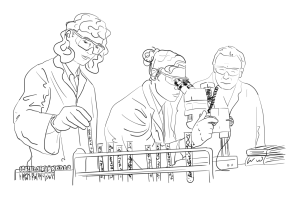
Illustration by Aedan Gardill
I caught Julia Nepper, a postdoctoral associate, on her way to a meeting. I really wanted to ask Julia specifically because she’s a fiction writer too and would know just what I meant. Agreeing to run to her meeting, which would free up another five minutes, she brainstormed possibilities with me. Austin Hall, a graduate student, strolled past her cubicle and the two of them came up with a brilliant idea: what if Olivia had found a strange fish swimming in her pond? She knew she had not put it there, and, well, ponds aren’t connected to any other bodies of water, so how could it have gotten in? They cooked up all kinds of experiments that would allow Olivia, through careful observation of local ponds, to solve the case of the Very Odd Fish. It was ducks that did it, see. Based on a real-life study that proved Mallards can eat and then unwittingly transport fish eggs to isolated water bodies, Austin and Julia spun a gripping web of science in minutes.
“Do you want to see something cool?” Austin asked, after Julia had to run. “Yes!” I said, and that was when the ground beneath me started sinking into a rabbit hole. Austin is a nature enthusiast bar none, and he is drawn to plants and fungi that survive in surprising ways. For the next hour or so, his screen flashed through images of rootless plants that only need air and water, white plants that don’t photosynthesize, mushrooms that parasitize other mushrooms and somehow turn their toxic hosts ripe for human consumption. All kinds of parasitic behaviors in the Kingdoms adjacent to ours that I’d never imagined possible. We emerged from our internet odyssey at 5.30pm, my brain bulging like an overstretched hamstring.
But how could I leave work when the door to Jo’s office was open? Joining the carousel of unexpected visitors I’d seen slipping in and out of her office, I posed Jo my question: Have you ever solved a small mystery? “Yes,” she said. But, as I listened, I quickly realized her discoveries were anything but small. Something strange, though, had caught her eye recently: a baby deer stranded in the prairie beyond her garden. It was, she said, a frequent phenomenon that, in her opinion, made no sense.
“Why do does leave their offspring to fend for themselves?” Jo asked, and promptly supplied the answer. Several answers, in fact, though she seemed unconvinced by all. One of them went like this: baby deer don’t smell and so they’re not at risk of predation, whereas their mums do smell. It’s safer, therefore, to keep their kids waiting for food in the tall grass than to take them along for the hunt. But, the baby deer Jo had seen was cold and very hungry. Why, from an evolutionary view, would a doe take this risk?
There aren’t any deer where Olivia lives in London, but I asked Jo to tell me what progress she makes with her case. Then, I ambled up the spiral staircase back to my office, basking in the glow of such a golden afternoon. That’s when I saw the little red light. The door to my office had locked with all my stuff still inside. Luckily, Namita Khajanchi, a graduate student at the Saha Lab, knew just what to do. She called the campus police and a uniformed man arrived to reunite me with my belongings. He’d been running all over campus, opening locked doors. I bet he’d solved his share of mysteries too, with such a mysterious job.
Although, the case of the Very Odd Fish and the Hungry Fawn may not feature in my book, these encounters with Julia, Austin and Jo filled me, again, with wonder. Their wonder for the world. And it was while riding that wave that an idea for the next book in the series finally emerged.